Background
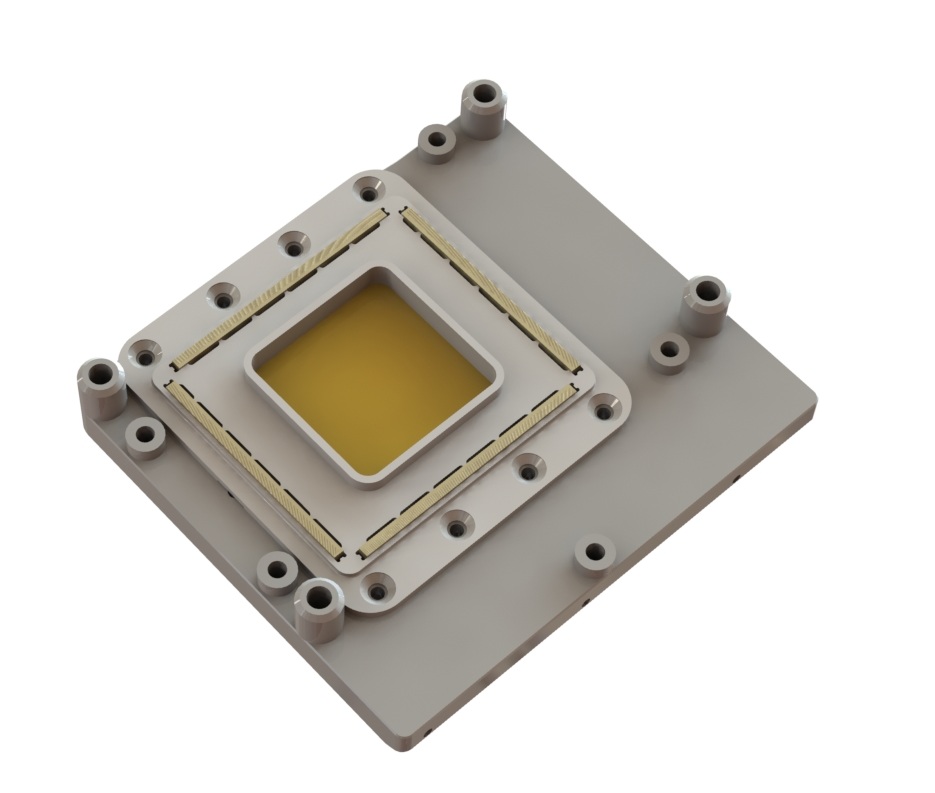
A customer developing a modular electronic system approached Z-Axis Connector Company while evaluating methods of transferring hundreds of signals and multiple high-current power channels between stacked printed circuit boards.
The application required an interconnect solution capable of handling both low-current signal routing and high-current power distribution within a compact mechanical envelope. Traditional pin-and-socket connectors were initially considered but quickly introduced concerns related to cost, size, contact density, and assembly complexity.
The customer began investigating elastomeric interconnect technologies as a potential alternatives.
Design Requirements
The proposed architecture consisted of approximately 400 total electrical connections distributed across multiple custom interconnects.
Key requirements included:
| Parameter | Requirement |
|---|---|
| Signal Contacts | 384 |
| Signal Current | 50 mA Continuous |
| Power Contacts | 16 |
| Peak Power Current | 6 A |
| Switching Frequency | 500 kHz |
| Duty Cycle | 1:8 |
| Board-to-Board Height | Approximately 0.060″ |
| Total Connector Length | Up to 4.0″ |
| Operating Temperature | -40°C to +85°C |
The majority of the connections carried low-level signals, while a smaller number of contacts were required to carry pulsed power currents up to 6 amps.
Because the power channels were multiplexed at a 1:8 duty cycle, the average current and resulting thermal load were substantially lower than the peak current values alone would suggest.
The Challenge

For applications with hundreds of contacts, conventional connector systems can introduce several design challenges.
As contact counts increase, connector costs typically scale directly with the number of pins. Mechanical alignment becomes more critical, connector bodies consume valuable PCB real estate, and assembly complexity increases.
The customer had already invested significant effort into the PCB architecture and signal routing. Any interconnect solution that required larger connector footprints, wider pad spacing, or additional board area would have forced a substantial redesign of the electronics and mechanical packaging.
Preserving the existing board architecture while accommodating nearly 400 electrical connections became a key project objective.
In this application, the customer was seeking an alternative that would:
- Reduce overall interconnect cost
- Support very high contact density
- Simplify board alignment
- Minimize connector height
- Accommodate both signal and power contacts
- Maintain reliable electrical performance
The engineering team recognized that elastomeric interconnects offered several advantages that traditional connector systems could not easily provide.
Evaluating Interconnect Technologies
Several interconnect approaches were considered during the design process, including traditional pin-and-socket connectors, spring-loaded contact systems, and custom elastomeric interconnects.
Conventional connector systems presented several challenges. With nearly 400 electrical connections, the physical size and cost of a traditional connector solution became significant. Tight mechanical tolerances and alignment requirements also added complexity to the assembly process.
Spring-loaded contact systems offered greater flexibility but introduced additional concerns related to component count, long-term reliability, mechanical complexity, and overall system cost when scaled to hundreds of contacts.
The engineering team ultimately focused on embedded-wire elastomer technology due to its unique combination of electrical and mechanical advantages.
Embedded-Wire Elastomer Technology
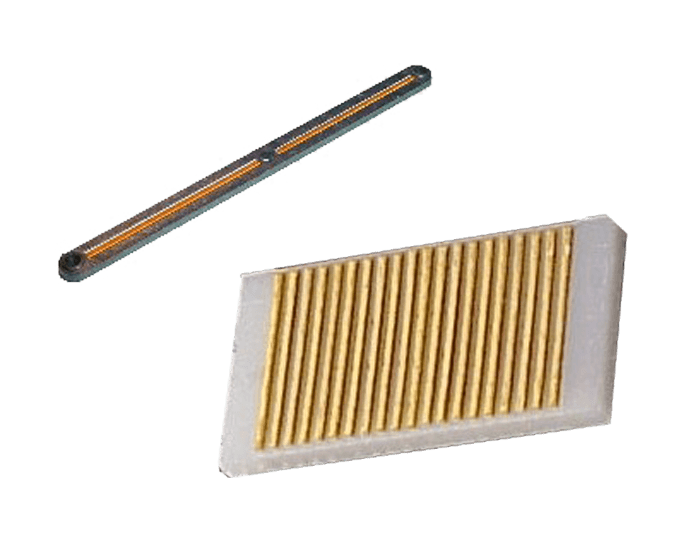
The selected approach utilized fine gold-plated conductive wires embedded within a compliant silicone elastomer matrix. Unlike traditional connectors that rely on individual pins, sockets, or spring contacts, the conductive paths are distributed throughout the elastomeric structure, creating a highly compliant electrical interface.
This approach offered several key benefits:
- Extremely low contact resistance
- High current-carrying capability
- Low-profile construction
- Reduced compression force
- High contact density
- Excellent signal integrity
- Tolerance to mechanical misalignment
- Customizable contact geometry
Because the conductive elements are embedded directly within the elastomer, the interconnect can accommodate minor variations in board flatness, coplanarity, and alignment while maintaining reliable electrical contact.
For this application, the technology also allowed signal and power connections to be integrated into a compact custom interconnect without the size, complexity, and cost associated with traditional high-pin-count connector systems.
Thermal Considerations
Environmental performance was another important consideration.
The customer established a target operating range of -40°C to +85°C to ensure compatibility with anticipated field conditions.
Unlike many conventional connector systems, conductive elastomer interconnects can be tailored using different silicone formulations to optimize performance for specific environmental requirements.
The design team reviewed available elastomer materials and discussed the impact of temperature on conductivity, compression characteristics, and long-term reliability.
This flexibility allowed the interconnect solution to be optimized around the actual operating environment rather than forcing the product design to conform to a standard connector offering.
Why Elastomeric Interconnects Were Selected
As the evaluation progressed, the advantages of a custom elastomeric solution became increasingly clear.
The customer recognized that elastomeric interconnects offered a unique combination of electrical and mechanical benefits:
- Hundreds of connections in a compact footprint
- Preserved the existing PCB architecture without requiring a redesign
- Simultaneous support for power and signal routing
- Reduced alignment sensitivity
- Lower profile construction
- Simplified assembly
- Scalable custom geometries
- Potentially lower overall system cost
Perhaps most importantly, the elastomeric interconnect allowed the customer to preserve the existing PCB architecture. Rather than redesigning the electronics around the limitations of a standard connector, the interconnect was custom-engineered to fit the available space, contact geometry, and electrical requirements.
This eliminated the cost, schedule impact, and technical risk associated with a major board redesign while still providing the required signal density and power-handling capability.
Results
The project demonstrated how elastomeric interconnect technology can provide an effective alternative to traditional connector systems in applications requiring:
- High contact counts
- Avoided a costly PCB redesign
- Mixed signal and power distribution
- Tight mechanical constraints
- Custom board-to-board interfaces
- Reliable electrical performance
By leveraging conductive elastomer technology, the customer was able to maintain their existing board architecture while implementing a high-density interconnect solution capable of carrying both signal and power connections. The result was a simplified system design that avoided the cost, schedule delays, and engineering effort typically associated with redesigning a complex electronic assembly around a conventional connector.
Conclusion
When contact counts reach several hundred connections and power distribution requirements must coexist alongside dense signal routing, connector selection becomes a system-level design decision.
For this application, conductive elastomer interconnects provided a compelling alternative to traditional pin-and-socket connectors by combining high density, low profile, mechanical compliance, and customizable electrical performance into a single interconnect solution.
More than a decade later, the same engineering principles continue to drive the adoption of elastomeric connectors in advanced medical, industrial, aerospace, and embedded electronic systems where traditional connector technologies reach their practical limits.
Have a Similar Application?
Every interconnect challenge is different. Whether you’re working with high contact counts, mixed signal and power requirements, fine-pitch interfaces, or space-constrained electronics, our engineering team can help evaluate potential solutions.
If you’re exploring alternatives to traditional connectors or would like feedback on a new design, we’d be happy to review your application.