
The Challenge
Many RF systems require a reliable connection between antennas, shields, modules, and printed circuit boards while operating within increasingly compact mechanical envelopes.
Traditional spring contacts and stamped metal contacts can present challenges related to assembly complexity, tolerance management, wear, and long-term reliability.
One customer approached Z-Axis Connector Company looking for an alternative solution for a high-frequency RF application. The goal was to create a compact, compliant interconnect capable of maintaining reliable electrical performance while simplifying the mechanical interface.
Evaluating an Elastomeric RF Interface
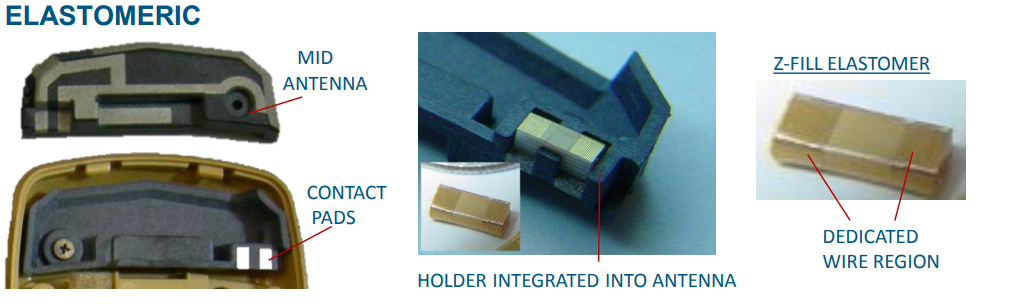
The solution selected was a custom Z-Fill elastomeric connector.
Unlike conventional spring contacts, Z-Fill connectors utilize precision conductive elements embedded within a compliant elastomer body. During assembly, the connector compresses between mating surfaces, creating multiple parallel conductive paths while accommodating dimensional variation between components.
The compliant nature of the elastomer helps maintain consistent contact force while eliminating many of the alignment and tolerance concerns associated with rigid contact systems.
High-Frequency Performance Testing
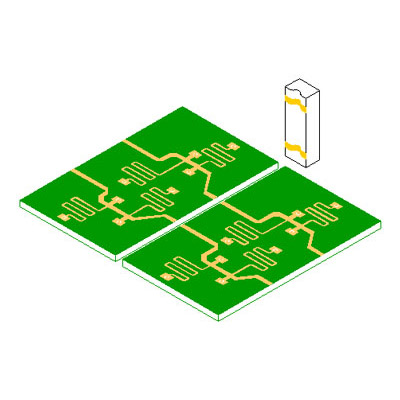
A key question for the customer was whether an elastomeric contact could support the required RF performance.
Testing was performed using custom Z-Fill geometries integrated into the customer’s RF structure.
The results exceeded expectations.
The elastomeric interface successfully transmitted RF signals up to 20 GHz while maintaining stable electrical performance.
Following the successful evaluation, the customer returned to purchase additional production quantities of the custom connectors.
Why Elastomeric RF Contacts Work
At RF frequencies, connector performance depends on more than simple DC resistance.
Contact geometry, impedance continuity, mechanical stability, and repeatable compression all influence overall system performance.
Elastomeric contacts offer several advantages:
- Consistent contact force across the mating interface
- Compliance that absorbs mechanical tolerances
- Reduced part count compared to spring-contact assemblies
- Compact integration into molded housings and RF structures
- Resistance to vibration and shock
- Simplified assembly for high-volume production
Because the conductive paths are distributed throughout the elastomer body, engineers can often create custom RF contact geometries that would be difficult or costly to achieve using traditional stamped metal contacts.
Common RF Applications
Custom elastomeric RF contacts are commonly used in:
- Antenna-to-PCB interfaces
- Antenna-to-module connections
- Shield grounding
- Wireless communication modules
- Embedded antennas
- Test and measurement equipment
- Military and aerospace electronics
- Medical RF devices
From Prototype to Production
One of the advantages of elastomeric technology is the ability to quickly customize connector geometry for a specific application.
In this case, multiple custom connector sizes were produced to fit the customer’s mechanical requirements while maintaining the RF performance demonstrated during testing.
The successful 20 GHz evaluation highlights the potential of elastomeric contacts as a practical alternative to traditional RF spring contacts in both prototype and production environments.
Looking Beyond Traditional RF Contacts
As wireless systems continue to shrink and operating frequencies continue to increase, OEM designers are constantly searching for ways to simplify assembly without sacrificing electrical performance.
This project demonstrated that a properly designed elastomeric RF contact can provide both mechanical and electrical advantages while supporting frequencies up to 20 GHz.
For engineers designing next-generation antenna systems, elastomeric interconnects may offer a valuable alternative worth considering.
Interested in evaluating an elastomeric RF interface for your application?
Contact Z-Axis Connector Company to discuss custom RF connector geometries, compression requirements, and performance goals.