
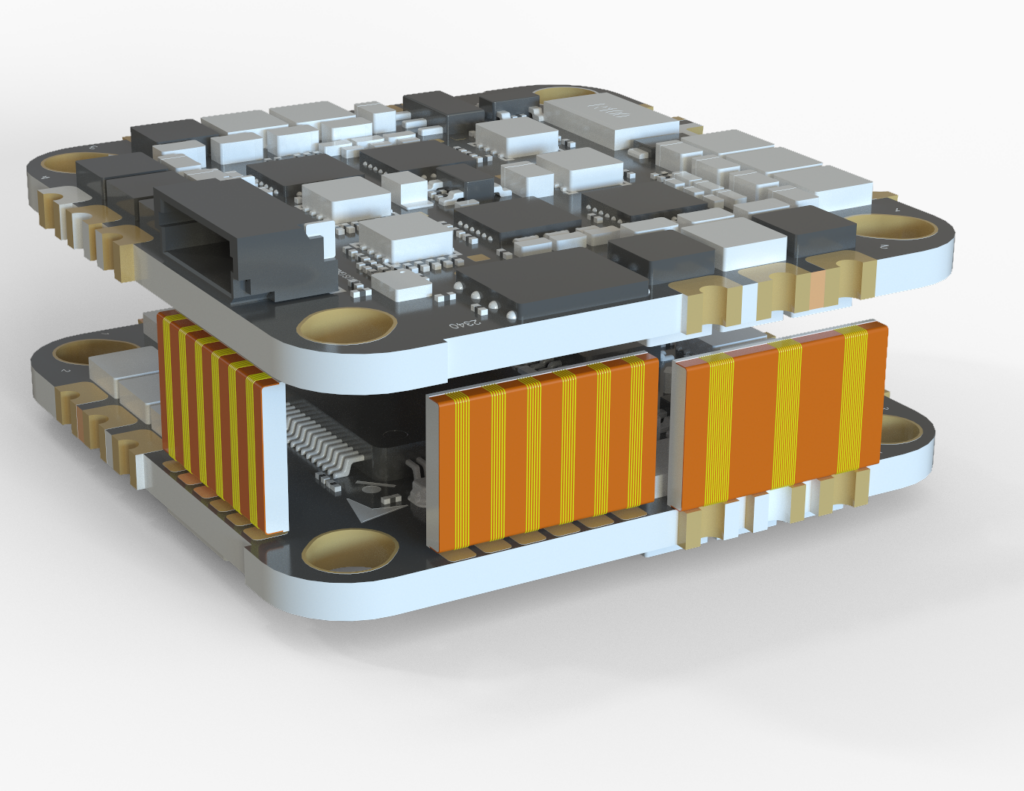
Traditional board-to-board connections rely on soldered headers, spring-loaded pins, or ZIF connectors. These approaches introduce wear points, alignment challenges, and often permanent interfaces that limit flexibility during testing and development.
Elastomeric connectors provide a different approach.
They create a direct, compressive electrical interface between PCBs without solder, without insertion cycles, and without fragile mechanical contacts.
Interfacing with SMD Pads
Elastomeric connectors can interface directly with flat SMD pads:
How it works:
- Conductive layers inside the elastomer are aligned with pad pitch
- Compression creates consistent electrical contact across all pads
- No soldering or mating cycles required
Advantages:
- Eliminates connector footprint and height
- Reduces mechanical complexity
- High cycle life compared to spring-loaded pins or ZIF
Interfacing with Castellated Edge Pads
The same elastomer approach works extremely well with castellated edges:
Why this works well:
- Castellated pads already expose conductive edges
- Elastomers conform to slight geometry variations
- Compression ensures reliable edge contact
Key benefit:
You can create a plug-less board-to-board interface without needing:
- Edge connectors
- Card slots
- Soldered modules
This is especially useful for:
- Module bring-up
- RF or sensor daughterboards
- Rapid prototyping systems
Mechanical Considerations
For a reliable elastomer interface:
- Compression control is critical
Typically 10–20% compression of the elastomer height - Alignment features
Use pins, pockets, or edge constraints to maintain registration - Even load distribution
Screws or a compression frame ensure uniform contact
Electrical Performance
Where This Approach Excels
Elastomeric interconnects are commonly used in both test environments and OEM product designs, especially where reliability, space, and cycle life are critical.
OEM / Production Applications
- Board-to-board interconnect in compact assemblies
Replace traditional connectors in space-constrained designs with a low-profile, compressive interface - Module-to-mainboard interfaces
Ideal for sensor modules, RF boards, and embedded subsystems using SMD or castellated pads - High-reliability applications
Eliminates failure modes associated with pin fatigue, misalignment, and connector wear over time - Sealed or semi-permanent assemblies
Works well in designs where boards are assembled once and retained with screws or a housing - Field-serviceable systems
Enables disassembly and reassembly without degrading contacts, unlike ZIF or pogo-based solutions
Test and Engineering Applications
- Production test fixtures
- Engineering validation setups
- High-cycle test environments
- Rapid prototyping and bring-up systems
Why OEMs Choose Elastomeric Interconnects
- Lower profile than traditional connectors
- Reduced BOM complexity
- Improved long-term reliability
- No insertion cycle wear
- Clean integration with existing PCB pad layouts
Why Elastomers Instead of Traditional Connectors
- No insertion wear
- No fragile pins
- No alignment damage
- Field-replaceable contact elements
- Cleaner mechanical design
Bottom Line
If your design currently depends on:
- ZIF connectors
- Spring-loaded pin blocks
- Soldered board stacking
An elastomeric interface can simplify the system while improving reliability and cycle life.