
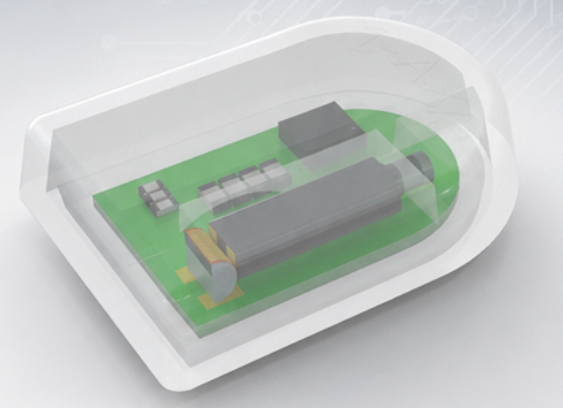
As medical electronics continue to shrink and conform to the human body, traditional interconnect methods are becoming a limiting factor.
The challenge is no longer just routing signals, it’s maintaining a reliable electrical interface over time.
The Limitation of Traditional Interconnects
Conventional solutions introduce tradeoffs that are increasingly unacceptable in medical OEM designs:
- Soldered connections
Permanent, rigid, and introduce thermal and mechanical stress - ZIF / board-to-board connectors
Add height, complexity, and long-term wear concerns - Spring-loaded contacts
Localized force, pad damage risk, and inconsistent long-term reliability
These approaches struggle in applications requiring:
- Compliance to non-planar or flexible surfaces
- Long-term reliability under micro-motion
- Minimal insertion force
- Compact, low-profile integration
A Different Approach: Elastomeric Interconnects
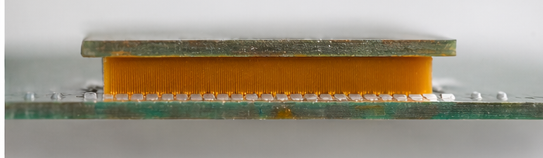
Z-Axis elastomeric connectors use embedded conductive elements within a compliant silicone matrix to create vertical electrical pathways under compression.
- Compliant interface that conforms to thin-film and flex circuits
- Distributed contact force across the entire pad area
- No sliding or scraping of contact surfaces
- Redundant conductive paths for each signal
The result is a stable electrical interface without the mechanical penalties of traditional connectors.
Designed for Integration into Medical Devices
Unlike test-oriented solutions, Z-Axis elastomeric connectors are engineered to be designed directly into OEM assemblies.
Key integration benefits:
Low Profile
- Minimal stack height compared to traditional connectors
- Enables tighter packaging in handheld and implantable systems
Mechanical Compliance
- Absorbs tolerance stack-up, flex variation, and surface irregularities
- Maintains contact under vibration, shock, and thermal cycling
Non-Destructive Interface
- Ideal for thin-film gold pads and delicate flex circuits
- Eliminates wear mechanisms associated with sliding contacts
Sealing & Environmental Resistance
- Elastomer body can contribute to environmental sealing
- Reduces exposure to fluids and contaminants in critical areas
Application Fit
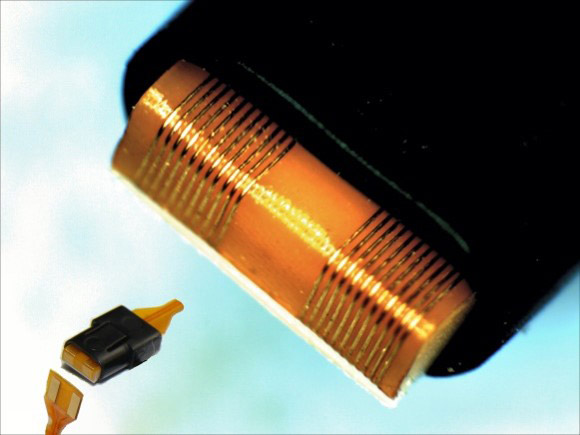
Z-Axis elastomeric connectors are well suited for:
Implantable & Long-Life Devices
- Pacemakers, neurostimulators, and implantable sensors
- Stable interconnect under long-term micro-motion
Wearable & Conformal Electronics
- Skin-mounted sensors and monitoring systems
- Maintains contact across flexible, moving surfaces
Miniaturized Diagnostic Systems
- Lab-on-chip and compact diagnostic modules
- High-density interconnect without connector bulk
Medical Instrumentation
- Catheters, probes, and surgical tools
- Reliable connection in constrained, dynamic environments
Reliability Where It Matters
Medical OEMs require interconnects that perform over time, not just at initial assembly.
Z-Axis elastomeric connectors provide:
- Consistent contact resistance over life
- Resistance to mechanical fatigue and wear
- Tolerance to repeated micro-movement
- High mating cycle capability where needed
Because the connection is compression-based rather than friction-based, failure modes associated with wear, fretting, and misalignment are significantly reduced.
Enabling Next-Generation Medical Designs
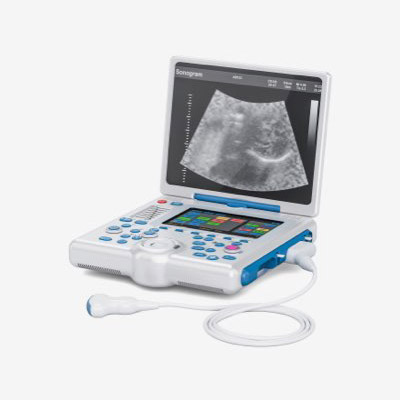
As thin-film and flexible circuits continue to evolve, the interconnect must evolve with them.
Elastomeric connectors enable:
- Smaller form factors
- More reliable interfaces
- Simplified mechanical integration
- Reduced long-term risk
The Bottom Line
For medical OEMs working with thin, flexible, and high-density circuits, the interconnect is no longer a commodity component, it is a critical design decision.
Z-Axis elastomeric connectors provide a compliant, low-profile, and highly reliable alternative to traditional connection methods. Purpose-built for modern medical device design.