

When engineers discuss current carrying capability, the conversation often begins with a simple question:
How many amps can the connector handle?
The answer depends on much more than a published current rating.
Conductor geometry, resistance, operating temperature, and the number of parallel conductors all influence connector performance.
At Z-Axis Connector Company, these factors are analyzed during the design process to predict voltage drop, power dissipation, and thermal behavior before a connector is manufactured.
The Physics Behind Connector Heating
As current flows through a conductor, resistance creates a voltage drop and generates heat.
Three fundamental equations describe this behavior:
| Equation | Description |
|---|---|
| V = I × R | Voltage drop across the conductor |
| P = I × V | Power dissipated as heat |
| P = I²R | Heat generation due to resistance |
The final equation is particularly important because power increases with the square of current.
Doubling the current results in four times the heat generation.
Tripling the current results in nine times the heat generation.
This relationship is one of the primary reasons connector current ratings must be carefully evaluated for each application.
Example Calculation
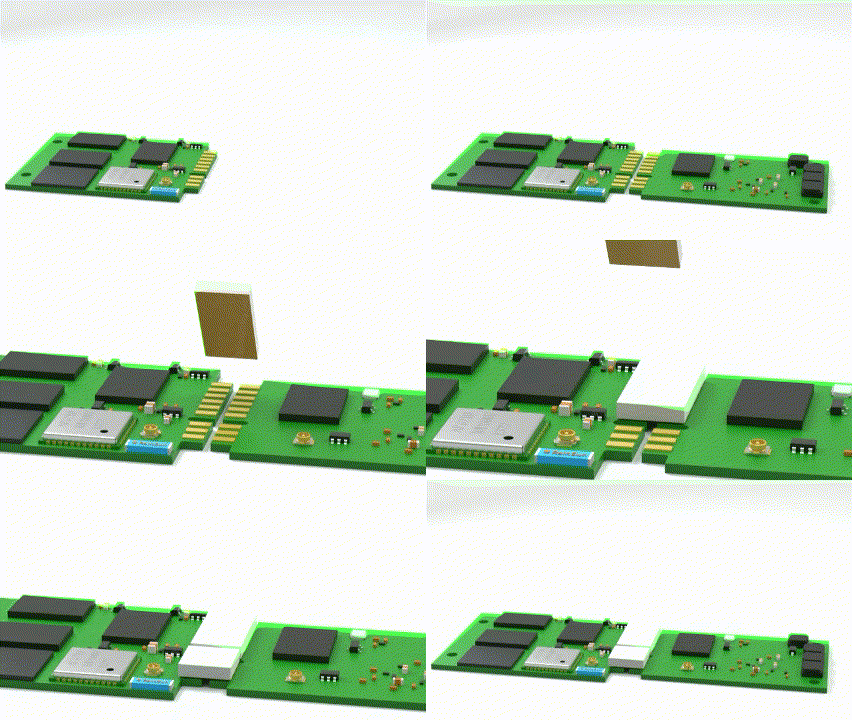
Consider a Z-Flat elastomeric connector designed to carry 4 amps.
Application Requirements
| Parameter | Value |
|---|---|
| Current | 4 A |
| Connector Height | 0.200″ |
| Gold Wire Diameter | 0.00198″ |
| Wire Pitch | 0.004″ |
| Parallel Conductors | 4 |
Using the conductor geometry and material properties, the connector resistance can be calculated.
Results
| Parameter | Value |
|---|---|
| Resistance | 0.0113 Ω |
| Voltage Drop | 45.2 mV |
| Power Dissipation | 181 mW |
From these values, engineers can evaluate both electrical performance and thermal behavior before the first prototype is produced.
Designing for Higher Current
Several design variables influence connector resistance:
- Gold wire diameter
- Number of parallel conductors
- Conductor pitch
- Conductor length
- Connector height
Increasing the number of parallel conductors reduces overall resistance, which lowers voltage drop and heat generation.
Likewise, increasing conductor diameter increases available cross-sectional area and improves current carrying capability.
Because elastomeric connectors are custom engineered, these parameters can be adjusted to meet the specific electrical and mechanical requirements of an application.
Beyond Current Ratings
Current ratings are useful, but they only tell part of the story.
Understanding resistance, voltage drop, and power dissipation provides a more complete picture of connector performance and allows engineers to make informed design decisions before hardware is built.
By combining conductor geometry with fundamental electrical principles, connector performance can be predicted, optimized, and validated early in the design cycle.